MS in Computer Science vs. Industry Experience: Does a Master’s Degree Accelerate Your Career?
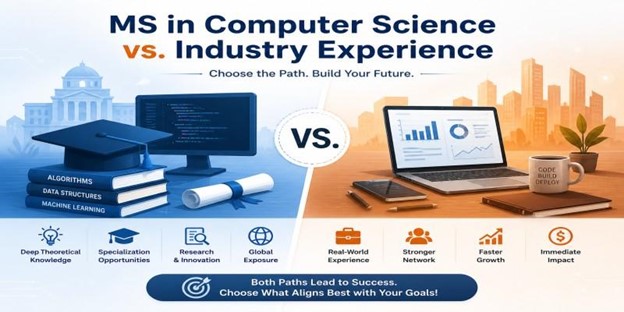
The tech industry moves at a breakneck speed, forcing developers, engineers, and data specialists to constantly evaluate how to stay competitive. A major crossroads that many professionals hit after a couple of years in the field is deciding whether to climb the corporate ladder through pure, hands-on industry experience or to step back into academia for a post-graduate qualification.
The debate between pursuing an advanced academic degree and racking up years of corporate desk time is nuanced. While raw code execution can be learned on the job, structural research, deep theoretical frameworks, and algorithmic optimization are where advanced academic pathways shine. Evaluating an option like an MS Computer Science requires a clear understanding of what you actually gain from a master’s program versus another two years of standard workplace engineering.
To determine which route truly accelerates your career, we must break down how these two distinct paths impact your technical authority, earning potential, and long-term trajectory.
Deep R&D vs. Practical Feature Delivery
In the day-to-day corporate world, the primary goal is shipping functional products. Developers are often under tight deadlines to fix bugs, build user interfaces, or deploy APIs. This environment is fantastic for learning workflow speed, teamwork dynamics, and practical engineering trade-offs, but it rarely leaves room to understand why a system functions the way it does at a hardware or deep mathematical level.
A Master of Science program flips this dynamic completely. Instead of rushing to ship a feature, you spend semesters analyzing algorithmic complexity, exploring advanced machine learning architectures, and working on computational problems.
- Industry Experience teaches you how to use existing frameworks, libraries, and cloud tools efficiently to meet business demands.
- An MS Degree teaches you: How to build those underlying frameworks, optimize algorithms from scratch, and innovate past the limitations of current tools.
If your career goal is to stay in standard web application development or basic IT administration, industry experience might give you a head start. However, if you aim to break into high-tier research, advanced cryptography, autonomous systems, or complex machine learning, the deep research and development (R&D) focus of a master’s degree becomes a strict requirement.
High-Tier Specialization: Moving Beyond the Basics
One of the greatest accelerators a master’s degree offers is the structure to transition from a generalist software engineer into a highly specialized domain expert. While a generalist can write versatile code across front-end and back-end web frameworks, specialized domains demand an entirely different layer of systemic thinking.
Consider fields like artificial intelligence, big data analytics, and predictive modeling. Understanding how to manage information across a comprehensive Data Science Lifecycle involves a deep dive into complex statistical analysis, multi-layered data cleaning pipelines, and advanced predictive modeling. Trying to learn these highly mathematical concepts purely through corporate trial-and-error can be slow and fragmented.
A rigorous academic environment provides a guided, concentrated setting to master these multi-phased pipelines, turning you into an authority who can make smart architectural decisions for complex data ecosystems rather than someone who merely fits pre-made models to basic datasets.
Career Lifespan and the Leadership Ceiling
While entry-level roles in the tech world heavily favor quick coding skills and practical portfolios, the metric changes dramatically as you move toward senior management, principal engineering, and executive technology roles such as a Chief Technology Officer.
| Career Aspect | The Industry Experience Route | The MS Computer Science Route |
| Initial Career Speed | Fast acceleration into mid-level engineering roles due to immediate practical familiarity. | Slightly delayed entry into the job market, but enters at a higher baseline position. |
| Technical Boundary | Often limited to the specific tools and legacy stacks used by your employers. | Highly adaptable; trained to understand underlying computational theory across any language. |
| Leadership Mobility | Can hit a ceiling where executive promotions require formal, advanced qualifications. | Preferred candidate for research leadership, international R&D positions, and academic roles. |
A master’s degree acts as a long-term insurance policy for your career lifespan. As tech ecosystems evolve and automation shifts standard programming roles, individuals with a deep command of core computer science principles can adapt effortlessly because they understand the foundational math and logic that never change.
The Power of the Local Tech Ecosystem
Many professionals assume that pursuing high-level research requires moving abroad immediately, but local advanced degrees have evolved rapidly. Modern universities have aligned their research labs with global industry standards, allowing graduate students to work on real-world industrial data problems without leaving the country. This bridge allows engineers to gain theoretical depth while remaining tightly plugged into local corporate tech networks.
Overcoming the “Self-Taught” Plateau
The internet is flooded with coding bootcamps and short certificate courses that promise quick entry into tech. While these routes are excellent for launching an initial career, many self-taught developers eventually hit a professional plateau. They find themselves struggling to understand low-level memory management, complex distributed systems, or formal software architecture patterns because their training skipped the fundamentals.
An MS in Computer Science forces you to confront these foundational gaps. It systematically fills in the blanks regarding operating systems design, advanced database theories, and formal computational logic, giving you the mental models needed to diagnose system failures that leave less-trained developers completely stuck.
Conclusion
Choosing between immediate industry experience and a Master’s degree is not a matter of finding a single right answer but rather about mapping out your ultimate career destination. If your immediate focus is entering the job market quickly and mastering current commercial tools, stacking up years of corporate experience will serve you well in the short term.
However, if you want to break through the mid-level management ceiling, pivot into cutting-edge fields like artificial intelligence, or drive actual tech innovation through corporate R&D, an advanced degree is a powerful career accelerator. Ultimately, combining a solid baseline of practical experience with the deep analytical authority of a master’s degree creates a highly resilient, future-proof profile that stands out in any global digital economy. To gain this competitive edge and master advanced engineering methodologies under expert academic guidance, exploring the advanced research facilities at The University of Faisalabad provides the perfect platform to transform your professional trajectory.