Is It Sciatica or Just Back Pain? Symptoms and 3 Relief Stretches

Almost everyone experiences lower back discomfort at some point, but not all back pain is created equal. When a dull ache turns into a sharp, electric shock that travels down your leg, you may be dealing with sciatica rather than a simple muscle strain. Institutions like The University of Faisalabad place a strong emphasis on educating rehabilitation experts about spinal mechanics, as distinguishing between nerve compression and localized muscle stiffness is critical for prescribing the right treatment.
Understanding the difference between general back pain and sciatica can save you weeks of discomfort and help you effectively target the root cause of your pain.
Sciatica vs. Standard Back Pain: Key Differences
While both conditions affect the lumbar region, their underlying causes and sensations differ significantly.
General Back Pain
Usually caused by muscle strains, ligament sprains, or poor posture. The pain remains localized to the lower back, feels like a dull ache or muscle tightness, and typically improves with rest and simple movement adjustments.
Sciatica
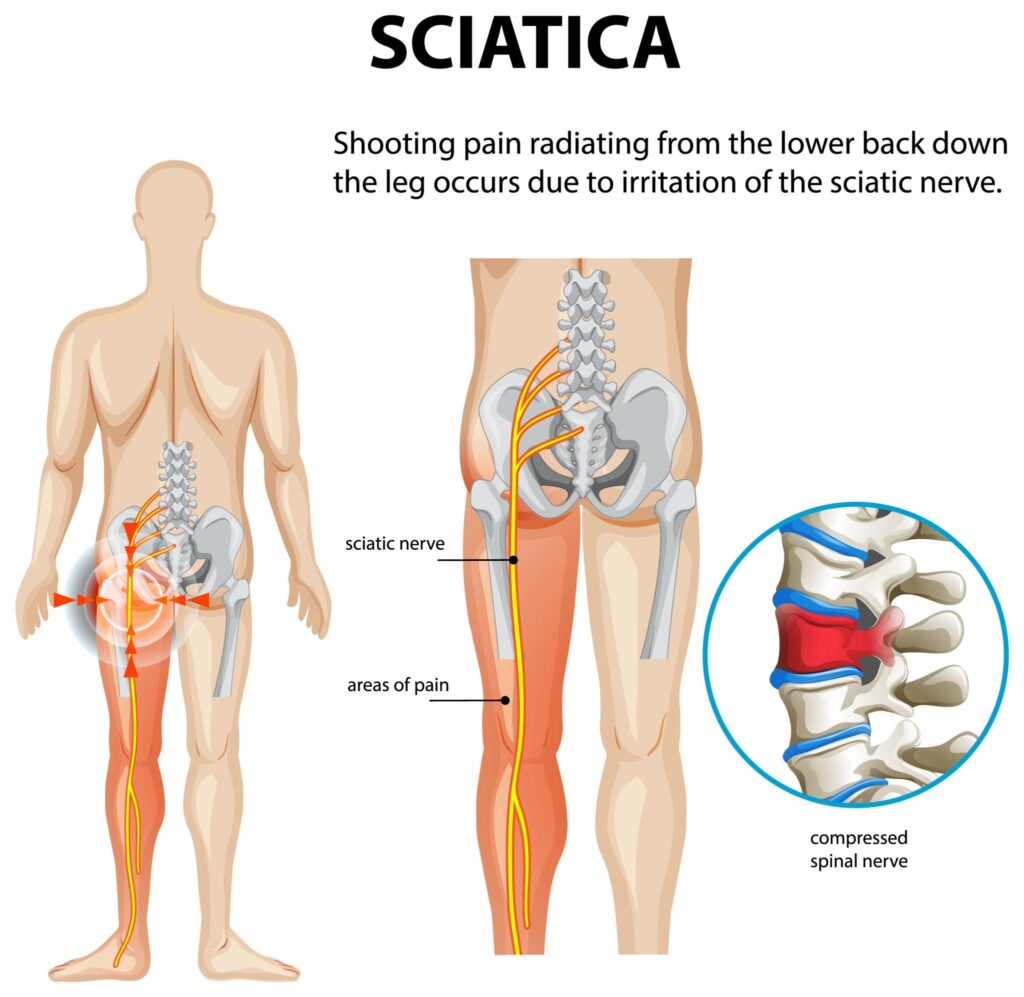
Occurs when the sciatic nerve, the longest nerve in your body, is compressed or irritated, often by a herniated disc or bone spur. It produces a burning, shooting, or electric-shock sensation that originates in the lower back, travels through the buttock, and radiates down one leg into the calf or foot.
Quick Symptom Comparison Checklist
| Symptom Feature | General Lower Back Pain | Sciatica |
| Pain Location | Confined to lower back/hips | Radiates down one leg (below the knee) |
| Sensation | Dull ache, stiffness, muscle soreness | Sharp, burning, or electric shock |
| Nerve Symptoms | Rare | Common (numbness, tingling, “pins & needles”) |
| Aggravating Factors | Bending, twisting, lifting heavy objects | Prolonged sitting, coughing, or sneezing |
Gentle Stretches for Sciatica and Back Pain Relief
If your discomfort is mild to moderate, targeted physical therapy stretches can help relieve nerve pressure and relax tight surrounding muscles.
Figure-Four (Piriformis) Stretch
- Target: Relieves tightness in the deep piriformis muscle, which often compresses the sciatic nerve.
- How to do it:
- Lie on your back with both knees bent and feet flat on the floor.
- Cross your right ankle over your left knee.
- Reach through your legs, grab the back of your left thigh, and gently pull it toward your chest until you feel a stretch in your right buttock.
- Hold for 20 to 30 seconds, breathe deeply, and switch sides.
- Repetitions: 2 to 3 reps per side.
Learning how to safely prescribe nerve-decompressing exercises like these forms the foundation of modern clinical training. Students enrolled in a Doctor of Physical Therapy (DPT) gain extensive hands-on experience in spinal assessment, kinesiology, and therapeutic exercise prescription to treat complex neuromuscular conditions safely.
Knee-to-Chest Stretch
- Target: Opens up the lumbar spinal joint spaces and eases lower back tightness.
- How to do it:
- Lie flat on your back with legs extended.
- Slowly bend one knee, pulling it up toward your chest with both hands.
- Keep your opposite leg flat on the floor and your lower back relaxed.
- Hold for 20 seconds, lower the leg gently, and repeat on the other side.
- Repetitions: 3 reps per leg.
Cobra Pose (Gentle Extension)
- Target: Helps reduce disc bulging and restores the natural curve of the lower spine.
- How to do it:
- Lie face down on a mat with your hands placed flat on the floor under your shoulders.
- Keeping your hips pressed lightly into the mat, gently push through your hands to lift your chest off the floor.
- Only go as far as comfortable without causing pinch-like pain in your lower back.
- Hold for 5 to 10 seconds, then lower down smoothly.
- Repetitions: 8 to 10 reps.
When to Consult a Clinical Specialist
While home stretches offer immediate relief for mild nerve irritation, persistent numbness, muscle weakness in the leg, or severe chronic spine issues demand professional medical evaluation. Advanced manual therapy and spinal decompression techniques are often required to achieve permanent recovery.
For medical professionals aiming to master non-surgical spine care, pursuing advanced postgraduate qualifications such as MS Physical Therapy Programs in Pakistan provides specialized expertise in orthopedic and neurological rehabilitation to manage high-risk cases effectively.
Conclusion
Distinguishing between general back pain and sciatica is the first step toward effective relief. While standard muscle tightness responds well to rest and gentle movement, sciatic nerve irritation requires careful, targeted stretches to relieve compression along the spinal path. By incorporating these three daily stretches into your routine, maintaining good posture, and knowing when to consult a rehabilitation expert, you can protect your spine and maintain a pain-free, active lifestyle.