Beyond the Classroom: How Innovative Pakistan 2026 is Redefining Youth Entrepreneurship
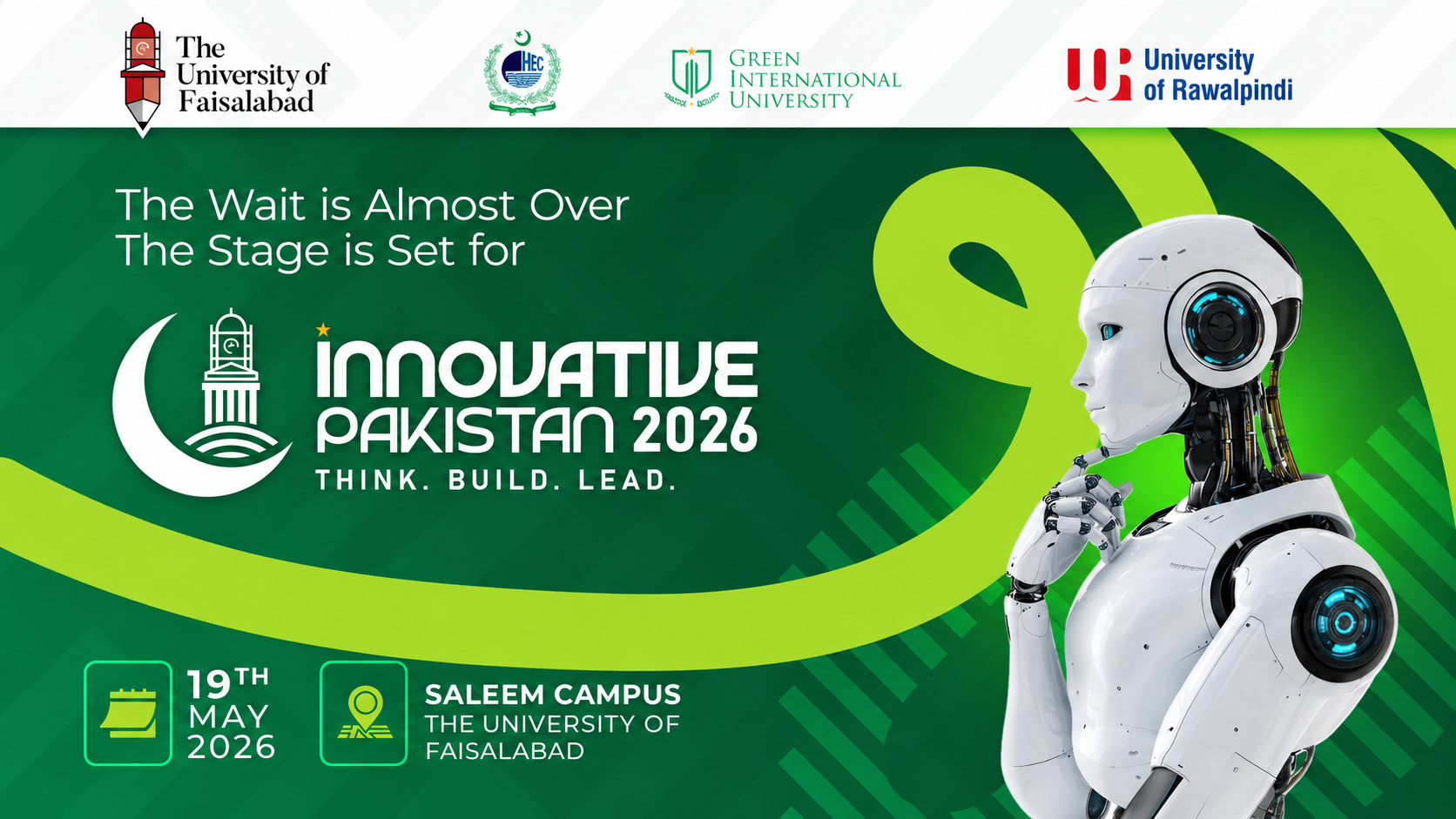
What happens to a brilliant idea when it stays trapped inside a student’s notebook or a hard drive? In most cases, it simply fades away. But the landscape of modern education and industry integration is shifting rapidly. Platforms like Innovative Pakistan 2026 are stepping in to break this cycle, turning academic concepts into tangible, real-world solutions.
Driven by the powerful mantra “Think. Build. Lead.”, this initiative has emerged as a premier launchpad for student innovation, tech-driven research, and multidisciplinary collaboration. It is no longer just about passing exams; it is about building the nation’s future from the ground up.
What is Innovative Pakistan 2026?
At its core, Innovative Pakistan 2026 is not just a standard university exhibition; it is a massive, multi-disciplinary national innovation ecosystem. It serves as a mega-confluence where academia, technological research, corporate industries, and venture capitalists meet under one roof.
Backed by the Higher Education Commission (HEC), this flagship platform brings together engineering marvels, AI software architectures, medical science breakthroughs, and business prototypes developed by the country’s sharpest young minds. It acts as a live testing ground where theoretical final-year projects are scrutinized, refined, and upgraded into market-ready commercial products.
Why is This Event Organized?
The gap between the traditional university curriculum and actual market demand is one of the biggest challenges for fresh graduates. This mega-event is organized with distinct strategic goals:
- To Eradicate Theoretical Monopoly: The primary objective is to shift our educational paradigm from passive rote-learning to aggressive, execution-based product development.
- To Bridge the Academia-Industry Divide: Corporate leaders often struggle to find industry-ready talent, while brilliant students struggle to find direct corporate access. This platform eliminates middle-channel friction by bringing both entities face-to-face.
- To Fuel the National Economy Through R&D: By commercializing student-led research, the event aims to foster a sustainable culture of indigenous technology, reducing reliance on imported software and engineering systems.
The Strategic Role of The University of Faisalabad (TUF)
As a pioneering institution, the University of Faisalabad (TUF) has taken the mantle to institutionalize this movement at a national scale. By hosting this multi-university collaborative arena at its state-of-the-art Saleem Campus, TUF provides more than just a venue.
The university injects its robust research ecosystem, advanced laboratory infrastructure, and cross-departmental mentorship into the mix. By partnering with external bodies like the HEC, Green International University, and the University of Rawalpindi, TUF serves as the ultimate anchor point, transforming Faisalabad into a central hub for nationwide technological breakthroughs.
How It Empowers Students Across All Pakistani Universities
This is not a localized campus activity; it is a wide-open gateway for talent from Karachi to Khyber. For a student participating from any university across Pakistan, the institutional advantages are massive:
1. Equal-Opportunity Tech Democratic Arena
Whether a student belongs to a premium tier-1 institute or a developing regional university, this platform democratizes exposure. Every single team gets the same floor space, the same elite panel of corporate judges, and the same access to national media and investors. Your execution defines your success, not your university credentials.
2. Radical Cross-Institutional Networking
When hundreds of projects from diverse provincial backgrounds exhibit together, it creates a unique collaborative friction. A software student from Rawalpindi can network with a healthcare innovator from Faisalabad or a business strategist from Lahore. This cross-pollination of ideas frequently leads to the birth of interdisciplinary startup teams.
3. Direct Route to Venture Capital & Commercialization
For an ambitious student team, getting a project funded independently is an uphill battle. Here, top angel investors, incubation managers, and corporate sponsors evaluate models live. Outstanding prototypes don’t just win certificates; they secure direct incubation slots, seed funding, and corporate sponsorships to launch their actual companies.
The Blueprint of Innovation: Breaking Down “Think. Build. Lead.”
To truly understand the impact of this platform, we have to look closely at the three core pillars that define its entire ecosystem. These aren’t just words; they represent the step-by-step journey of a student transforming into a future industry leader.
THINK: Cultivating the Mindset of a Problem Solver
Innovation doesn’t start with code or machinery; it starts with a question. The “Think” phase challenges students to look at their surroundings and identify real-world friction points. Whether it is a bottleneck in local agri-tech, an inefficiency in healthcare data management, or a gap in sustainable engineering, students are encouraged to shift from passive learners to critical thinkers.
BUILD: Turning Raw Theory into Interactive Prototypes
This is where the magic happens and where traditional classroom learning ends. The “Build” phase is all about execution. Under this framework, students leverage modern laboratories, academic mentorship, and collaborative research environments to build Minimum Viable Products (MVPs). Seeing a final-year project transition from a theoretical flowchart into a functional, working model is where true technical confidence is born.
LEAD: Taking the Stage and Scaling to the Market
Building a great product is only half the battle; knowing how to present, defend, and scale it is what creates leaders. The “Lead” phase gives students the platform to pitch their models directly to industry experts, corporate judges, and seasoned professionals. It teaches the young workforce how to market their ideas, handle critical feedback, and view their academic projects through a commercial, business-oriented lens.
Why This Ecosystem is a Game-Changer for the Youth
For any ambitious student, engaging with a platform designed around national innovation offers massive professional leverage that goes far beyond a standard university degree.
- Bridge to the Corporate World: Cold pitching on job boards rarely works for fresh graduates. This ecosystem brings industry decision-makers, talent acquisition managers, and tech professionals directly to the students, creating an organic networking ground.
- From FYP to Commercial Startup: Most Final Year Projects (FYPs) end up as dusty documentation. A structured innovation platform identifies projects with genuine commercial viability and helps guide them toward incubation, mentorship, and potential investment.
- Developing Essential Soft Skills: Technical expertise is crucial, but teamwork, high-pressure communication, and presentation skills are what make a candidate stand out in the corporate market. Defending a project in front of an expert panel accelerates this growth exponentially.
Conclusion
Innovative Pakistan 2026 is proof that when youth are given the right resources, a supportive research culture, and a clear path, they don’t just mimic existing technology; they create new benchmarks. By championing the philosophy of Think, Build, and Lead, this platform is successfully bridging the gap between academia and industry. It is empowering students to realize that they don’t have to wait for graduation to make an impact. They can start engineering real-world solutions today.
Looking for more insights on academic transformations, student-led tech breakthroughs, and upcoming national research avenues? Explore our comprehensive educational blog archive to see how modern learning paradigms are reshaping Pakistan’s professional horizon.